
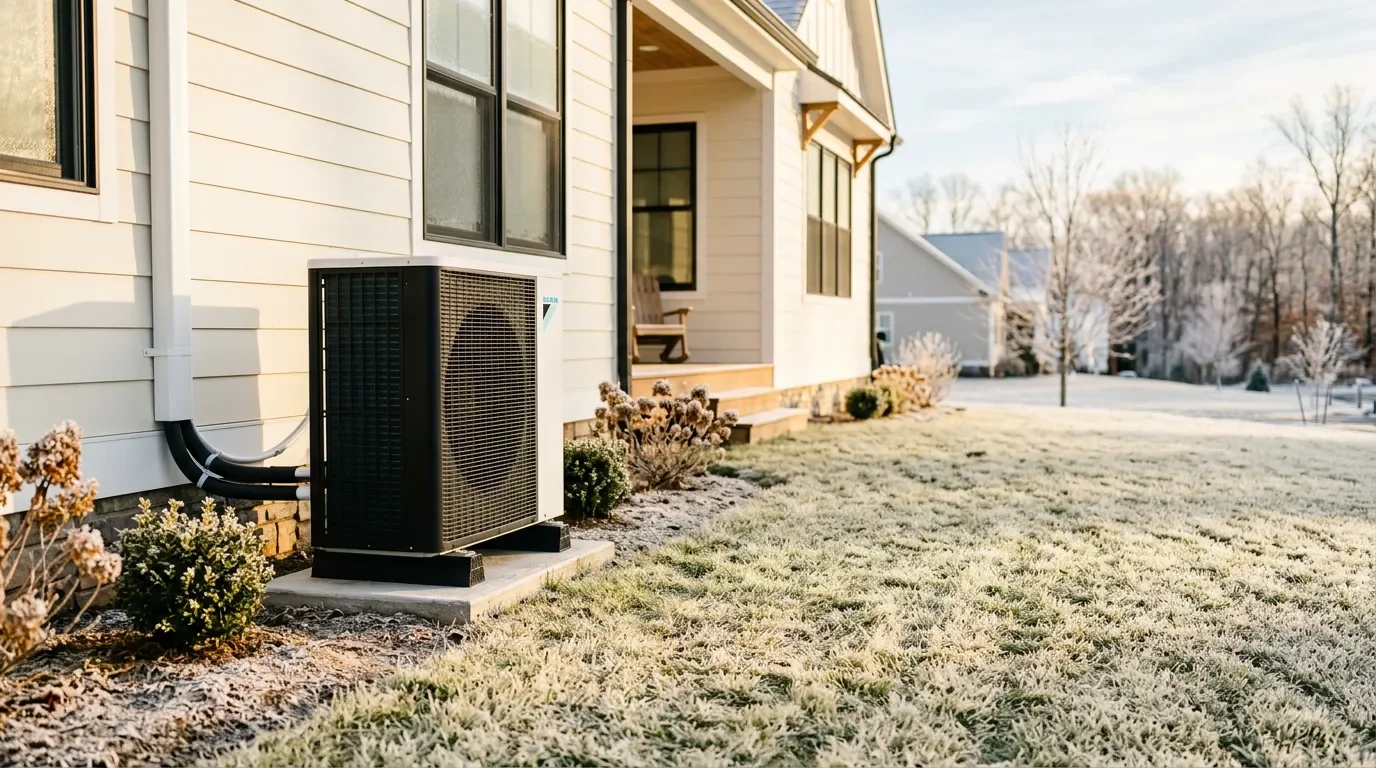
When replacing an aging heating system in Northern Virginia, homeowners must choose between an electric heat pump and a natural gas furnace. Both systems have advantages, and the optimal choice depends on your home's insulation, existing fuel sources, and energy goals.
The Mechanics of Gas Furnace Heating
Natural gas furnaces generate heat through combustion. The heat exchanger absorbs this combustion heat, and the blower fan circulates warm air through the home's ducts. Furnaces are rated by their Annual Fuel Utilization Efficiency (AFUE) percentage.
Standard furnaces operate at 80% AFUE, meaning 80% of the fuel is converted to heat while 20% escapes through the exhaust flue. High-efficiency condensing furnaces achieve 95% to 98% AFUE. They feature a secondary heat exchanger that extracts extra heat from the flue gases, turning water vapor into condensate.
Gas furnaces provide hot supply air (typically 120 to 140 degrees Fahrenheit), which warms a cold house quickly. This makes them highly effective during extreme winter cold snaps when temperatures drop below freezing.
The combustion process requires safety controls. The primary safety is the flame sensor, which uses flame rectification to verify ignition. If the burners ignite but the sensor fails to detect the flame, the control board shuts down the gas valve to prevent unburned gas from accumulating.
We inspect the heat exchanger during maintenance visits using video scopes. Even a hairline crack can leak carbon monoxide into your home's air. If we find a crack, the heat exchanger must be replaced to protect your family's safety.
The Physics of Heat Pump Heating
Heat pumps do not burn fuel. Instead, they use electricity and refrigerant to extract heat from the outdoor air and transfer it inside. In summer, they reverse this process to act as an air conditioner.
Because they transfer heat rather than creating it, heat pumps are efficient. During mild winter days (above 40 degrees), a heat pump can deliver three times more heat energy than the electrical energy it consumes. This efficiency is measured by the HSPF2 (Heating Seasonal Performance Factor 2) rating.
However, as the outdoor temperature drops, the amount of heat energy available in the air declines. The system must work harder, and its heating capacity drops. Below 30 degrees, standard heat pumps require auxiliary electric heating coils (heat strips) to maintain indoor temperatures. These electric strips use significant energy, reducing overall efficiency.
To prevent ice buildup on the outdoor coil, heat pumps enter a defrost cycle. The system switches to cooling mode temporarily, warming the outdoor coil to melt the ice while using indoor electric heat strips to keep your home comfortable. We verify defrost board operations and temperature sensors to ensure this cycle runs efficiently.
The Dual-Fuel Hybrid Solution
A dual-fuel hybrid system combines the strengths of both technologies. It pairs an electric heat pump with a high-efficiency gas furnace.
During mild winter weather, the electric heat pump handles the heating demand efficiently. When the outdoor temperature drops below freezing, the system automatically switches to the gas furnace. This switch provides comfortable heat and protects the heat pump from running at low efficiency.
We install dual-fuel systems across Fairfax County. This setup lowers monthly heating bills, provides reliable warmth, and reduces carbon emissions by using electricity during milder winter days.
We help you evaluate your home's insulation, local gas rates, and electrical panel capacity to recommend the heating system that fits your comfort needs. We size the equipment correctly using Manual J load calculations, ensuring reliable winter heating and energy savings.
Which Heating Choice Fits Which Home
The right heating system depends on the house, not a single fuel preference.
| Home Condition | Heat Pump Fit | Gas Furnace Fit | Dual-Fuel Fit |
|---|---|---|---|
| Existing gas service and good vent path | Possible, especially as part of dual fuel | Strong fit | Strong fit |
| No gas service | Strong fit if electrical capacity supports it | Usually not practical without gas extension | Usually not practical without gas |
| Older ducts with high static pressure | Needs duct review before selection | Needs duct review before selection | Needs duct review before selection |
| Homeowner wants one outdoor unit for cooling and heating | Strong fit | Furnace still needs separate AC | Strong fit with heat pump plus furnace |
| Concern about cold snaps | Cold-climate model or auxiliary heat needed | Strong fit | Strong fit |
| Interest in federal heat pump tax credit | Qualifying systems may be eligible up to $2,000 | Furnace-only replacement does not qualify for that heat pump credit | Heat pump portion may qualify if requirements are met |
Heat Pump Coefficient of Performance (COP)
The Coefficient of Performance measures heat pump efficiency at specific temperatures. A COP of 3 means the system delivers three watts of heat for every watt of electricity consumed.
During mild winter days, Bryant Evolution heat pumps can achieve COPs exceeding 3.5. As outdoor temperatures fall, the COP declines, eventually dropping toward 1.5 at freezing temperatures.
We analyze these efficiency curves alongside local utility rates to establish the balance point for your dual-fuel setup. This ensuring the system switches to gas heating at the exact temperature where gas becomes more economical.
Understanding the Balance Point in a Real House
A balance point is where heat pump theory meets the actual house. The thermal balance point is the outdoor temperature where the heat pump can no longer supply enough heat to match the home's heat loss. The economic balance point is the temperature where another fuel, usually gas in a dual-fuel system, becomes cheaper to run than the heat pump.
Two homes on the same street can have different balance points. Insulation, window quality, air leakage, duct location, return-air capacity, and thermostat strategy all change the load. A tight home with good ducts may let a heat pump carry the load well into cold weather. A leaky home with attic ducts may need auxiliary heat sooner, even with similar equipment.
This is why we do not set dual-fuel switchover by habit. We look at the heat pump capacity, furnace capacity, utility rates, and the Manual J load. The thermostat can then switch fuels at a temperature that makes sense for that home. Set too high, the furnace runs when the heat pump could be efficient. Set too low, the heat pump may run hard while the home falls behind.
Venting and Electrical panel requirements
Installing a high-efficiency condensing furnace requires proper venting. We route two PVC pipes from the furnace to the exterior of your home: one for combustion air intake and one for exhaust gas disposal.
We calculate the equivalent length of the PVC run, taking into account elbows and fittings, to ensure the draft inducer fan can vent the combustion gases safely.
Upgrading to an electric heat pump can also require electrical modifications. We check your main panel capacity, verifying that you have sufficient amperage to support the compressor and auxiliary heating circuits, upgrading breakers as required by code.
Cold-climate heat pump technology
Older heat pumps struggled in cold weather because their compressors could only run at one speed. When outdoor temperatures dropped below 35 degrees, a single-speed compressor could not extract enough heat from the air, and the system relied on electric backup strips that consume large amounts of electricity.
Modern cold-climate heat pumps solve this problem with larger compressors, enhanced vapor injection (EVI), and wider operating ranges. EVI systems inject a small amount of intermediate-pressure refrigerant vapor into the compressor scroll during heating mode. This raises the discharge temperature and pressure, allowing the compressor to produce useful heating capacity at outdoor temperatures as low as -13 degrees Fahrenheit.
For Fairfax County, where winter low temperatures typically range from 15 to 25 degrees, cold-climate heat pumps can handle the heating load without backup strips on all but the coldest nights. This represents a significant improvement over even the heat pumps we installed ten years ago.
Variable-speed inverter compressors explained
A variable-speed inverter compressor converts AC power from your electrical panel into DC power, then uses an inverter board to create a new AC signal at a variable frequency. The frequency controls the compressor motor speed. A higher frequency spins the motor faster, increasing refrigerant flow and heating or cooling output. A lower frequency reduces the speed, lowering output to match mild conditions.
This means the compressor does not cycle on and off like older systems. Instead, it runs continuously at whatever speed matches your home's current demand. On a 50-degree winter afternoon, the compressor might run at 30% speed, delivering gentle warmth at high efficiency. On a 20-degree winter night, it ramps up to 80% or 100% speed to maintain your set temperature.
The result is steady indoor temperatures without the hot and cold swings caused by on-off cycling. It also reduces wear on the compressor because starting a motor under full load creates the most stress on its electrical windings and mechanical bearings.
Bryant dual-fuel models we install
Bryant offers several heat pump and furnace combinations designed specifically for dual-fuel operation. The Evolution 280A variable-speed gas furnace paired with the Evolution 288B variable-speed heat pump is the top-tier combination. The thermostat manages the switchover automatically based on outdoor temperature, and you can set the balance point during installation.
For homeowners looking for a mid-range option, we often pair the Preferred 226A furnace (96% AFUE, two-stage) with the Preferred 225C heat pump. This gives you two-stage heating from both the gas and electric sides, at a lower price point than the variable-speed Evolution equipment.
Both combinations require the Evolution or Preferred thermostat to coordinate the switchover. We program the balance point based on your local gas and electric rates. In the Fairfax County area, with current Dominion Energy electric rates and Washington Gas pricing, the economic crossover typically falls between 30 and 38 degrees, depending on the specific equipment efficiency.
Lifecycle cost analysis: heat pump vs. furnace
The upfront cost of a heat pump system is usually higher than a gas furnace paired with a standard air conditioner. But a heat pump handles both heating and cooling in a single outdoor unit, which eliminates the need for a separate air conditioner. When you compare the combined cost of a furnace plus air conditioner against a heat pump plus air handler, the difference narrows.
Operating costs depend on local fuel prices. In Northern Virginia, natural gas has historically been cheaper per BTU than electricity. A 96% AFUE gas furnace burning natural gas at current Washington Gas rates costs roughly $0.85 to produce 100,000 BTUs of heat. A heat pump with a COP of 3.0, running on Dominion Energy electricity, costs roughly $1.10 to produce the same 100,000 BTUs when temperatures are above 35 degrees. Below 35 degrees, the heat pump's COP drops, and the cost per BTU rises.
Over a 15-year equipment life, a dual-fuel system often produces the lowest total cost because it uses the heat pump's efficiency during mild weather and switches to gas only when electricity becomes more expensive. We run these calculations for each customer based on their home's heating load and actual utility rates, so the recommendation is specific to their situation.
Heat Pump vs. Furnace FAQ
It should not. Emergency or auxiliary heat should come on when the heat pump cannot carry the load, during defrost, or under specific control conditions. If auxiliary heat runs constantly during mild weather, the system may have a control, refrigerant, airflow, or sizing problem.
It can be both. The heat pump runs efficiently during milder weather, while the gas furnace provides strong output during colder periods. The balance point can be set using the home's load and utility rates, so each fuel is used where it makes sense.
Sometimes, but it depends on age, coil compatibility, refrigerant, efficiency goals, and physical condition. If the cooling system is also near end of life, a combined replacement may give better equipment matching, warranty coverage, and efficiency documentation.
Heating Replacement Questions to Ask
These questions make a replacement proposal more useful.
- What is the Manual J heating load? This tells you what the house needs at design conditions.
- What is the winter design temperature used? Fairfax County planning should reflect local winter conditions around 17 to 22 degrees.
- What happens below the balance point? Ask whether auxiliary heat, gas heat, or a dual-fuel switchover carries the load.
- Can the electrical panel support the heat pump and backup heat? Panel capacity matters before equipment is ordered.
- How will duct static pressure be handled? A new system needs enough airflow to deliver its rated comfort.
- What permits are required? Equipment replacement is regulated work under Virginia code.
Need a hand? Talk to a NATE-certified technician about your system — call (703) 436-8028 or schedule service online.